
Betty's Accessibility and Infrastructure Questions, Answered
We are grateful to local disability rights advocate Betty Tegel for her thoughtful questions about the main library building project.
The Carnegie Library's inaccessibility is one of the main drivers behind the Library Trustees’ pursuit of a new main library. In a new library building, patrons would no longer have to contend with steep stairs, narrow aisles, or the building’s single, tiny, inaccessible restroom.
Indeed, the new building was designed to meet – and often exceed – American Disability Act (ADA) requirements. The space between bookcases would be wide enough to allow motorized wheelchairs as well as strollers through, and books would not be shelved overhead or close to the floor, ensuring that everyone has access to library collections. Accessible restrooms, an elevator, and the main service desk would all be steps away from the parking lot entrance, ensuring easy navigation for those utilizing the accessible parking spots.
Betty's letter to the editor appeared in the 4/23 edition of the Montague Reporter. She begins:
I understand there are proposed plans for a new library on Avenue A, across from the Shady Glen. This, along with other budget items, will be addressed at the town meeting in May. Warrant articles include the school budget, police budget, and other financial issues.
I hereby submit questions for all you readers about the proposed library project.
Betty's questions and answers, compiled by Will Quale, Trustees Chair; Chris Nolan-Zeller, Assistant Town Administrator; and Caitlin Kelley, Library Director, are listed below.
A: The state grant is for $11.3 million, or just under half the project’s cost estimate, leaving the town responsible for the remaining $12.4 million, which would be financed through 30-year bonds. The tax impact on residential property owners is $49 per $100,000 of assessed value; on commercial/industrial property owners, $81 per $100,000 of assessed value. The average single-family home in Montague is currently assessed at $325,699, so the impact on that homeowner would be $159/year, or about the same as one $3 cup of coffee a week.
A: There are a few ways of looking at this one – it’s less straightforward than homeowners, who directly receive a property tax bill from the town. From a nitty-gritty math angle, the residential property owner pays taxes at the same residential rate – so they’ll see the same $49/$100,000 impact as a homeowner. If they were to pass 100% of that along to their tenants, then you could divide the amount by the number of units and then by 12 months to arrive at – for a sample of 26 multi-unit buildings in Montague including Power Town, Sunrise Terrace, Park Villa, Keith Apts, and the Cutlery Block – about $3/month impact on tenants.
That said, in practice, rents are driven much more by “the market” than by costs. Rents increase over time. The next time your rent increases, it will be because of various costs plus market forces, but the amount of that increase which is directly attributable to the community’s share of our investment in a new main library building will be about $3/month for the average apartment.
That investment will pay big dividends to everyone – homeowners and renters alike – whose tax dollars contribute to the building. Just two examples: we’ll have a lot more space for our Library of Things collection – which includes things like power tools, kitchen appliances, board games, telescopes … stuff you want to use once in a while, you’ll be able to borrow for free. And we’ll have space for programs, classes, and workshops – art, yoga, tech support, bike repair, quilting, and of course readings, writing workshops, and book discussions – all for free. Interested in something else? Tell us – this is your library, and we’ll try to make it happen!
A: A standalone traffic study specific to the library project has not been completed. Traffic, circulation, and parking considerations have been reviewed as part of prior planning efforts, including a 2022 Turners Falls Parking Study, and through ongoing review by Town staff and project consultants during the design process.
A: There are crosswalks on all sides of the Ave A/Second St and Ave A/Third St intersections with tactile sidewalk bumps, and the crosswalks at Ave A/Third St are further protected by flashing and auditory signals activated by pedestrian push-button. The town has made a great effort to increase pedestrian safety and accessibility accommodations at these crosswalks in the heart of downtown, surrounded by some of the town’s most-visited locations including the Discovery Center, Shea Theater, Country Creemee, Shady Glen, Rendezvous, and Town Hall, which is in part why the town administration specifically recommended this location for the new library building.
A: The green space (38 Avenue A) and parking lot (Second Street municipal parking lot) are owned by Montague’s Economic Development & Industrial Corporation, not by the Discovery Center (or its parent, the state Department of Conservation and Recreation). In 2012, after the former Cumberland Farms building had sat vacant for over a decade, Montague negotiated an agreement with the EDIC and DCR regarding 38 Avenue A. The agreement stipulated that any future development must be "compatible with the aesthetics of the Great Falls Discovery Center and its use with the historical uses of [the property]” and clarified that a “cultural building may be constructed upon [the property], so long as it meets the aforesaid criteria."
A library following the historical aesthetics of the Avenue fully satisfies DCR’s demands ensuring harmonious purpose and appearance with the Discovery Center, and the EDIC has strongly backed the library project and enthusiastically agreed to this use of their property. Library staff are thrilled at the prospect of deepening our partnership with the Great Falls Discovery Center and further collaborating on programming and initiatives.
Construction vehicles would be located on the library site and the Discovery Center would not close.
A: With popular programming like Bilingual Music and Movement, playgroups, LEGO at the Library, and author readings bringing dozens of kids and families each day to the library children’s room designed to meet the needs of Montague’s families, it’s hard to imagine any better location in town for an ice cream shop! And the plans for the new library include several cafe sets along Second Street, right across from the Creemee, where people can enjoy their ice cream outdoors, shaded by beautiful new trees.
A: The Second Street municipal parking lot includes approximately 66 parking spaces, of which 4 are designated ADA accessible spaces. During construction, portions of the parking area may be temporarily unavailable due to installation of underground building infrastructure. Following construction, the parking area will be restored. Additional parking and circulation analysis is available in the 2022 parking study, which was incorporated into the project planning process and may be referenced for further detail. Additional parking is available behind Town Hall and more parking spots could also be added on 2nd Street.
A: YES! The building is in full compliance with the ADA, and exceeds ADA requirements in several areas to accommodate larger motorized wheelchairs as well as strollers.
A: Yes, the children’s room is on the second floor for safety. Elevator capacity and design would be determined during the final design phase, after the project has been voted for, however it is the intention of the Library Building Steering Committee that the elevator would accommodate large families and prioritize ease of access and use for people of all abilities. The libraries would budget for regular elevator maintenance and inspection to ensure its functionality, just like town hall does.
A: The new building is larger but much more efficient to heat and cool than the Carnegie, and its heating and cooling systems are all electric, eliminating volatile heating oil bills and ending our reliance on the Carnegie’s ancient and expensive heating infrastructure. The building’s electricity costs will be significantly reduced by the grant-funded solar panels on the roof, which will offset between 30-50% of the building’s total electricity cost.
The new building requires one new part-time Library Assistant working 12 hours a week to cover the children’s desk on evenings and Saturdays, and we are budgeting for 8 additional hours of custodial work per week.
Altogether, this gives an estimated increased annual operating cost of $27,126 to $48,230 depending on electricity usage and solar efficiency. These operating costs may be offset by renting the community room for private events, such as birthday parties, corporate events, and weddings.
Plowing, sidewalks, and street lighting around the property are town services for infrastructure that already exists and is already maintained by the town. Any increase in sewer and water usage would be directly attributable to the new building having multiple fully ADA-compliant accessible restrooms, while the Carnegie has none.
A: The multi-purpose programming and community room can be reserved for public or private after-hours use. Use for public events is free, and we look forward to building on our partnerships with organizations like the Council on Aging, Brick House, and Heartwing Center, as well as fostering many new connections. After-hours use for private events – such as birthday parties or weddings or conferences – is something we could charge a reasonable fee for, offsetting the building’s operating costs.
A: There is no anticipated need to close Avenue A during construction.
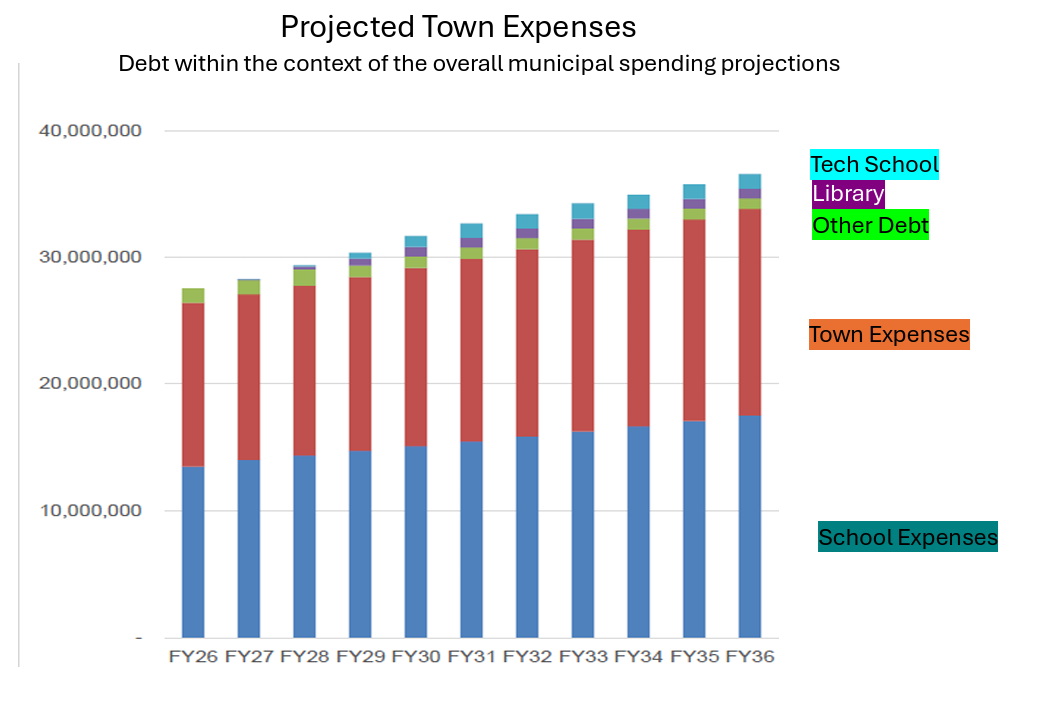
A: As you can see from the bar graph below, this project would be a very small addition to the town’s overall expenses. Montague residents’ state taxes have been funding this library construction program for decades, building libraries in Greenfield, Deerfield, Erving, Wendell, Sunderland, Leverett, Shutesbury, Amherst, Hadley… and if we don’t build this library, we will be funding libraries in other towns for decades to come without the chance to benefit from this program. Federal funds for many programs that people rely on have been cut in recent years. Libraries are uniquely positioned to support vulnerable populations who are most affected by these cuts. A new library facility is the strongest investment we can make in our our community to ensure Montague remains strong and resilient.
A: The Carnegie building is owned by the town, and would undergo a similar process to the old DPW highway garage once the new one was built in 2020: the Select Board will be in charge of writing a Request for Proposals, and can specify preferred uses (such as a cultural institution) or disallowed ones (such as a donut shop). The building’s exterior is protected by the Massachusetts Historical Commission, who have indicated they will forbid changes to the building’s Avenue A and Seventh St sides by any owner. The Select Board will ultimately select a proposal and move forward with selling the building. Without the need to house tens of thousands of books, a new owner would have flexibility to redesign the interior.
A: No. The new building would not serve as an emergency evacuation center. That said, the building design does include infrastructure for a generator, so that if the power goes out for long periods of time the first floor of the building could be used as a resource center where people could stay warm or cool–depending on the weather–and could recharge their phones and connect with loved ones.
A: The project site is located in a developed downtown area that already contains a mix of residential, commercial, and civic uses. As with any construction project in an active downtown environment, there will be temporary impacts during construction, including construction vehicle traffic, noise, and temporary changes to parking and pedestrian circulation. These impacts will be managed through applicable permitting requirements and coordination with Town departments. Following construction, the site is expected to function as a public library within the existing downtown street network. The project includes design features intended to support pedestrian access, accessibility, and safe circulation in coordination with existing sidewalks, crosswalks, and municipal infrastructure. Site selection and project design were informed by prior planning efforts, including community input and the 2022 parking study, which identified pedestrian access, walkability, and downtown connectivity as relevant considerations in evaluating public facility locations.
A: We did! As part of the Planning and Design Phase site surveys and both geotechnical and engineering reports of the site and proposed structure were completed.
A: The building was designed based on extensive community survey data and focus group responses that highlighted the needs of the community and balanced that with the motto,“everything we need and nothing that we don’t.” The resulting 20,779 square feet building fully meets the described needs of the community and does so with much greater efficiency than the plan to expand the Carnegie in 2004. 20% non-functional space here vs 30% there.
It should also be noted that the architects and Library Building Steering Committee planned for the space to be as flexible as possible, located unmovable items like stairs and restrooms along the perimeter of the building, so that the building could be easily changed 50-60-or 70 years down the road to meet the future needs of the community.
A: Yes, lighting that provides for a safe pedestrian experience will be prioritized.
The Libraries have a great relationship with the DPW. In addition to ensuring building maintenance and snow removal after the building has been completed, they would also be consulted during the paving and landscape design phase to ensure that hardscapes and plantings will be easily managed post-construction.
A: Investing in our community’s resilience by providing a library that meets all of our needs, which is fully accessible to all of our residents, and which takes full advantage of a generous, competitive state grant to maximize the value our residents get for their tax dollars is our top priority.